
What Is Claude Opus 4.7 | Key Points on Performance, Pricing, and Breaking Changes
For developers who want to know what changed in Claude Opus 4.7 and what to watch out for during migration, here is a concise breakdown of the key points on performance, pricing, and breaking changes. From CursorBench 70% and high-resolution vision to the new xhigh effort level and Task Budgets, all the way to the API parameter changes that trigger HTTP 400 errors — explained in the order you need to know before starting implementation.
Opus 4.7 is the latest flagship model that reached GA on April 16, 2026, with major enhancements in coding and visual tasks — including CursorBench 70% and 2,576px high-resolution vision — delivering simultaneous improvements in performance while keeping pricing unchanged.
On the implementation side, the recommended starting point is to build coding and agent workflows around the new xhigh effort level, and to set Task Budgets (beta) in agent loops as a safeguard against runaway usage. Pricing remains at $5 input / $25 output per MTok, unchanged from Opus 4.6, so existing cost estimates can be reused.
The critical concern is breaking changes to API parameters: setting temperature, top_p, top_k, or Extended Thinking Budget now returns HTTP 400 errors, so you must remove these from your request payloads and rewrite your code to use Adaptive Thinking before migrating.
Contents (16)
- What Is Claude Opus 4.7 — GA on 2026-04-16, Currently the Highest-Performance General-Purpose Model
- Performance Highlights — Improvements Across 4 Areas: Coding, Vision, Long-Running Agents, and Knowledge Work
- Performance 1/4: Coding — CursorBench 70%, CyberGym Tasks Solved 3x, Self-Verification Also Improved
- Performance 2/4: Vision — 2,576px / 3.75MP Support, XBOW 98.5%, 1:1 Coordinate Mapping
- Performance 3/4: Long-Running Agents — Finance Agent 0.813, xhigh / Task Budgets Added
- Performance 4/4: Knowledge Work — .docx Redlining, .pptx Editing, and Improved FS Memory Accuracy
- Pricing — $5 Input / $25 Output per MTok, Unchanged from Opus 4.6
- Breaking Changes — Messages API Users: Watch Out for 4 Types of 400 Errors
- 1. Sampling Parameters Removed — temperature / top_p / top_k Return 400 Error for Non-Default Values
- 2. Extended Thinking Budget Removed — Must Rewrite to Adaptive Thinking
- 3. Thinking Content Omitted by Default — Restore with display: "summarized"
- 4. Tokenizer Change — Up to 35% More Tokens, Ensure Sufficient max_tokens Headroom
- Practical Impact and Migration — 4-Point Checklist and New Adoption Considerations
- Migration Checklist for Existing Opus 4.6 Users — Remove Parameters, Switch to Adaptive, Add display, Increase max_tokens
- Considerations for New Adoption — Pure Performance Improvement at Unchanged Pricing, Token Consumption Requires Real-World Testing
- Sources (Primary Information)
What Is Claude Opus 4.7 — GA on 2026-04-16, Currently the Highest-Performance General-Purpose Model
Claude Opus 4.7 is Anthropic's flagship model. In Anthropic's official documentation it is described as "our most capable generally available model to date" source.
The API model ID is claude-opus-4-7. The context window is 1 million tokens (1M),
the maximum output tokens is 128,000 tokens, and it supports Adaptive Thinking
source.
Performance Highlights — Improvements Across 4 Areas: Coding, Vision, Long-Running Agents, and Knowledge Work

A summary of the 4 areas improved in Opus 4.7. Details are covered in each section below.
Performance 1/4: Coding — CursorBench 70%, CyberGym Tasks Solved 3x, Self-Verification Also Improved
Anthropic's official announcement shows improvements across multiple coding benchmarks source.
| Benchmark | Opus 4.7 | Opus 4.6 |
|---|---|---|
| CursorBench | 70% | 58% |
| 93-task coding benchmark (improvement over Opus 4.6) | +13% | — |
| CyberGym production tasks solved (vs. Opus 4.6) | 3x | — |
(Source: Anthropic official)
In addition, code self-verification capability has improved, making it easier to maintain consistency even during long coding tasks (source: Anthropic official).
Performance 2/4: Vision — 2,576px / 3.75MP Support, XBOW 98.5%, 1:1 Coordinate Mapping
This is the first time in the Claude series that high-resolution image support has been included source.
| Item | Opus 4.7 | Previous Models |
|---|---|---|
| Max resolution (long edge) | 2,576px | 1,568px |
| Max resolution (area) | approx. 3.75MP | approx. 1.15MP |
(Source: Anthropic official)
On the visual accuracy benchmark (XBOW), Opus 4.7 scored 98.5% while Opus 4.6 scored 54.5% source. Coordinate mapping is now 1:1 pixel-accurate, eliminating the need to calculate scale factors source.
Note that high-resolution images increase token consumption. If the additional image precision is not required, downsampling images before sending them can reduce token usage source.
Performance 3/4: Long-Running Agents — Finance Agent 0.813, xhigh / Task Budgets Added
On the Finance Agent evaluation, Opus 4.7 scored 0.813 versus Opus 4.6's 0.767, and Anthropic describes it as "state-of-the-art" on the GDPval-AA evaluation source.
The new xhigh effort level has been added.
For coding and agent use cases, it is recommended to start with xhigh
source.
Task Budgets are also available as a public beta. You can set a target for token usage across an entire agent loop, and the model will self-manage its budget while completing the task source.
Performance 4/4: Knowledge Work — .docx Redlining, .pptx Editing, and Improved FS Memory Accuracy
Key points for this section are summarized below.
- Improved quality for
.docxtracked changes (redlining) and.pptxediting - Improved read/write accuracy for filesystem-based memory (scratchpads and note files)
Source: source
Pricing — $5 Input / $25 Output per MTok, Unchanged from Opus 4.6
Key points for this section are summarized below.
| Category | Unit Price (excl. tax, USD) |
|---|---|
| Input tokens | $5.00 / 1M tokens |
| Output tokens | $25.00 / 1M tokens |
There is no price change from Opus 4.6 source. Always check source for the latest and most accurate pricing.
Breaking Changes — Messages API Users: Watch Out for 4 Types of 400 Errors
These apply if you are using the Messages API directly. If you are using Claude Managed Agents, there are no breaking API changes source.
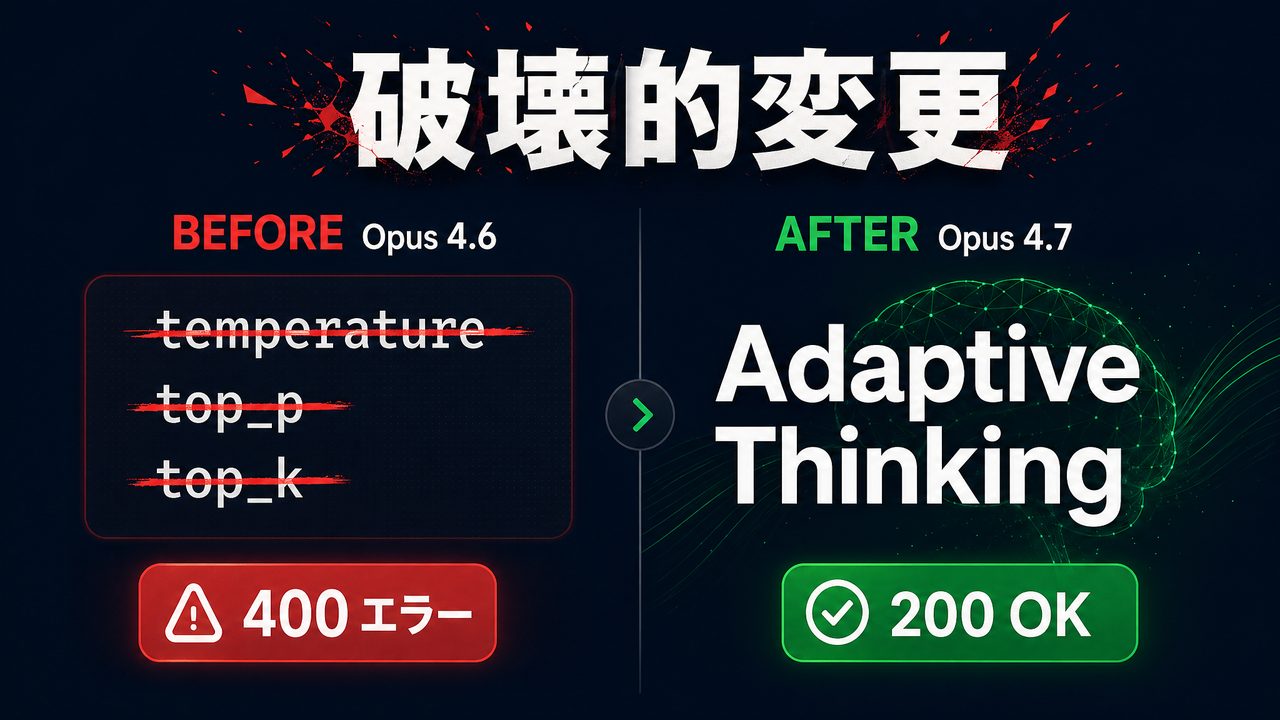
Left: Old Opus 4.6 parameters (now return 400 errors). Right: New syntax for Opus 4.7.
1. Sampling Parameters Removed — temperature / top_p / top_k Return 400 Error for Non-Default Values
Setting temperature, top_p, or top_k to non-default values will return
400 errors. The safest approach is to remove these parameters entirely from your requests.
Note that temperature = 0 was never a guarantee of identical output
source.
2. Extended Thinking Budget Removed — Must Rewrite to Adaptive Thinking
Setting thinking: {"type": "enabled", "budget_tokens": N} now returns 400 errors.
To enable thinking, use Adaptive Thinking instead
source.
# Opus 4.6 (old)
thinking = {"type": "enabled", "budget_tokens": 32000}

# Opus 4.7 (new)
thinking = {"type": "adaptive"}
output_config = {"effort": "high"}
Adaptive Thinking is off by default. When using it, explicitly set thinking: {type: "adaptive"}.
3. Thinking Content Omitted by Default — Restore with display: "summarized"
Thinking content is no longer included in responses by default (no error is raised).
If you need reasoning output, set the display field
source.
thinking = {
    "type": "adaptive",
    "display": "summarized",  # or "omitted" (default)
}
4. Tokenizer Change — Up to 35% More Tokens, Ensure Sufficient max_tokens Headroom
A new tokenizer has been adopted, and the same input may use
up to approximately 35% more tokens compared to Opus 4.6 (1.0x to 1.35x depending on content type).
It is recommended to update your max_tokens parameter to a value with sufficient headroom
source.
Practical Impact and Migration — 4-Point Checklist and New Adoption Considerations
Migration Checklist for Existing Opus 4.6 Users — Remove Parameters, Switch to Adaptive, Add display, Increase max_tokens
Key points for this section are summarized below.
- Requests that explicitly set
temperature/top_p/top_k→ remove the parameters - Code that sets
thinking.budget_tokens→ rewrite to Adaptive Thinking format - Logic that parses Thinking content → add
display: "summarized" max_tokensvalues → update to values with sufficient headroom accounting for the tokenizer change
For Claude Code and Agent SDK users, automated migration of your codebase is available via the Claude API skill source.
Considerations for New Adoption — Pure Performance Improvement at Unchanged Pricing, Token Consumption Requires Real-World Testing
For products where high-resolution vision, coding accuracy, or long-running agent tasks are requirements, Opus 4.7 is worth considering. Since API pricing is the same as Opus 4.6, it can be evaluated as a pure performance improvement.
However, the tokenizer change may affect cost estimates. It is recommended to measure actual token consumption on representative workloads before migrating to production.
Sources (Primary Information)
The primary sources referenced directly in writing this article are listed below. Always verify the latest accurate information at each link.
- Anthropic: Introducing Claude Opus 4.7 — Official announcement (2026-04-16)
- Anthropic official: What's new in Claude Opus 4.7 — API breaking changes and new feature details
- Anthropic official: Opus 4.7 Migration Guide — Opus 4.6 → 4.7 migration steps
- Anthropic: Pricing — Latest pricing (accessed: 2026-04-23)